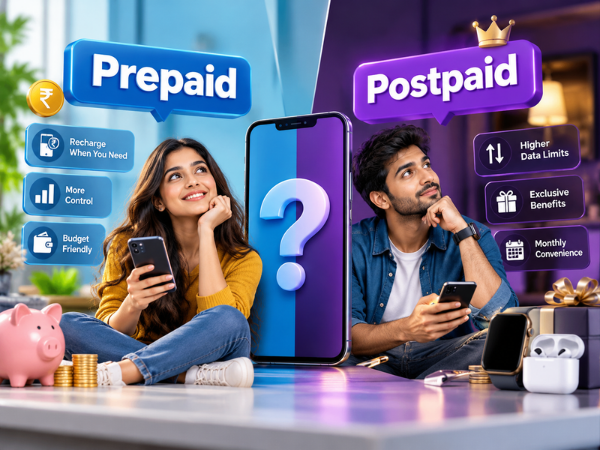
Choosing between a prepaid and postpaid mobile connection can affect your monthly expenses, data usage and overall mobile experience. While prepaid plans let you pay in advance and manage your spending, postpaid plans offer monthly billing and may include additional benefits such as OTT subscriptions, data rollover or family connections.
But which option is actually better? The answer depends on how much data you use, how you manage your budget and whether you value flexibility or convenience.
Let's understand the key differences between prepaid and postpaid connections and find out which one suits your needs.
What Is a Prepaid Mobile Connection?
A prepaid connection requires you to pay for mobile services before using them. You recharge your number with a plan that provides specific benefits, such as calling, mobile data, SMS and a validity period.
Once your plan expires or its applicable usage limit is reached, you may need to recharge or purchase an additional pack to continue using those benefits.
Benefits of Prepaid Plans
- Better budget control: You pay upfront, making it easier to manage your mobile expenses.
- Flexible recharges: You can choose from available plans with different prices, data allowances and validity periods.
- No regular monthly bill: You don't receive a recurring postpaid bill for your plan.
- Suitable for limited usage: Prepaid can work well if you use mobile data occasionally or primarily need calling services.
- Easy to compare plans: You can review available recharge options before deciding how much to spend.
Disadvantages of Prepaid Plans
- You need to remember recharge dates and plan validity.
- You may run out of high-speed data before your plan expires.
- Additional data packs can increase your expenses if you frequently exceed your allowance.
- Some postpaid-specific benefits or bundled services may not be available with your selected prepaid plan.
Best for: Students, budget-conscious users, secondary SIM users and people who want greater control over mobile spending.
What Is a Postpaid Mobile Connection?
A postpaid connection allows you to use mobile services throughout a billing cycle and pay the bill afterwards. Your monthly bill generally includes the rental or charges for your selected plan, applicable taxes and any additional usage or services.
Postpaid plans may also offer bundled entertainment subscriptions, data rollover, international roaming options or family connections, depending on the operator and plan.
Benefits of Postpaid Plans
- Convenient monthly billing: You don't need to recharge manually every time your monthly billing cycle begins.
- Additional plan benefits: Selected plans include OTT subscriptions, data rollover or other bundled services.
- Family connections: Eligible plans may allow multiple mobile numbers under a shared account.
- Detailed bills: Monthly statements can help you review charges and understand your usage.
- Useful for regular users: Postpaid can suit professionals and families who prefer a predictable billing arrangement.
Disadvantages of Postpaid Plans
- Monthly bills may be higher than the prepaid alternatives you would otherwise choose.
- Additional usage, international roaming or chargeable services can increase the bill.
- You need to monitor your usage and understand the plan's limits and terms.
- Bundled subscriptions may not provide much value if you don't use them.
Best for: Working professionals, families, frequent travellers and users who prefer monthly billing and bundled benefits.
Prepaid vs Postpaid: Key Differences
|
Feature |
Prepaid |
Postpaid |
|
Payment |
Pay before using services |
Pay after the billing period |
|
Billing |
Recharge-based |
Monthly bill |
|
Budget control |
Easier to cap spending on the selected plan |
Requires monitoring of bills and extra charges |
|
Recharge reminders |
Usually necessary |
Generally not required for monthly plan renewal |
|
Data allowance |
Depends on the selected recharge |
Depends on the selected monthly plan |
|
Extra benefits |
Available on selected plans |
May include subscriptions, rollover or family benefits |
|
Best suited for |
Users prioritising flexibility and spending control |
Users prioritising convenience and bundled benefits |
Actual prices and benefits vary by telecom operator and plan. Neither connection type automatically guarantees better network coverage or faster internet.
Which Is Cheaper: Prepaid or Postpaid?
For many users, prepaid is an attractive option because it allows them to select a plan based on their budget and avoid a recurring bill. However, prepaid is not automatically cheaper in every situation.
For example, consider two users.
User A primarily makes calls, uses messaging apps and occasionally browses the internet. A suitable prepaid plan may meet these needs without paying for benefits they rarely use.
User B uses mobile data extensively, needs several connections for family members and regularly uses subscription services. A postpaid plan could offer better overall value if its included benefits replace expenses they already incur separately.
The important point is to compare the total cost over a month or year rather than looking only at the advertised plan price.
Before switching, check the data allowance, validity, taxes, additional charges and the actual value of bundled benefits.
Does Postpaid Offer Faster Internet Than Prepaid?
Not necessarily. Internet speed depends on several factors, including your telecom operator, network coverage, signal strength, device compatibility, network congestion and plan-specific conditions.
Some plans may have different high-speed data allowances or speed restrictions after a usage threshold is reached. This can make one plan appear faster than another in everyday use.
If internet speed is your main concern, compare the plan's data policy and coverage in your area rather than assuming that postpaid is always faster.
Prepaid vs Postpaid for Different Types of Users
For Students
Prepaid is often a practical choice for students who want to manage expenses and select a plan according to their monthly budget. A postpaid plan may still be worthwhile if its benefits suit their needs.
For Working Professionals
Postpaid can be convenient for professionals who prefer monthly bills and need reliable access to calling and data services. Prepaid remains a good option for those who prefer paying in advance.
For Families
Postpaid family plans may provide value when multiple connections can share eligible benefits under one account. Compare the total family cost against separate prepaid recharges before deciding.
For Heavy Data Users
Neither option is automatically better. Compare the high-speed data allowance, applicable speed limits and additional data charges. Choose the plan that provides sufficient data at a reasonable total cost.
For People Who Travel Frequently
Frequent travellers should compare network coverage, roaming benefits and international roaming charges. A suitable prepaid or postpaid plan can work, depending on the destinations and services required.
Can You Switch From Prepaid to Postpaid or Vice Versa?
Yes. In India, eligible subscribers can generally migrate between prepaid and postpaid services while retaining their mobile number, subject to the telecom operator's process and applicable requirements.
Before switching, compare the new plan's benefits, billing cycle, outstanding dues where applicable and any conditions attached to bundled services.
You can also check the official guidance available from the Telecom Regulatory Authority of India (TRAI) at https://www.trai.gov.in/.
Frequently Asked Questions
Which is better, prepaid or postpaid?
Prepaid is generally a good choice for users who prioritise budget control and flexible recharges. Postpaid may suit people who prefer monthly billing, family connections or useful bundled benefits.
Is prepaid cheaper than postpaid in India?
Prepaid can be cheaper for users with straightforward mobile needs, but the best-value option depends on the plans being compared and the user's actual usage.
Can I use 5G on a prepaid SIM?
Yes, prepaid users can access 5G where supported by their operator, device, plan and local network conditions. Eligibility and benefits vary by operator.
Does postpaid have unlimited data?
Not every postpaid plan offers unlimited high-speed data. Some plans have usage limits, fair-use policies or speed restrictions. Always read the applicable plan terms.
Can I switch without changing my mobile number?
Eligible subscribers can generally migrate between prepaid and postpaid services without changing their number. Confirm the procedure with your telecom operator.
Final Verdict: Which One Should You Choose?
Choose prepaid if your priority is controlling expenses. It allows you to pay upfront, select a suitable recharge and avoid a recurring monthly bill.
Choose postpaid if your priority is convenience and useful bundled benefits. Monthly billing, family connections and selected subscriptions can make it worthwhile when they match your actual needs.
Ultimately, neither option is universally better. Compare the total cost, data allowance, validity, additional charges and benefits before making your decision. The best mobile connection is the one that fits your usage without making you pay for services you don't need.