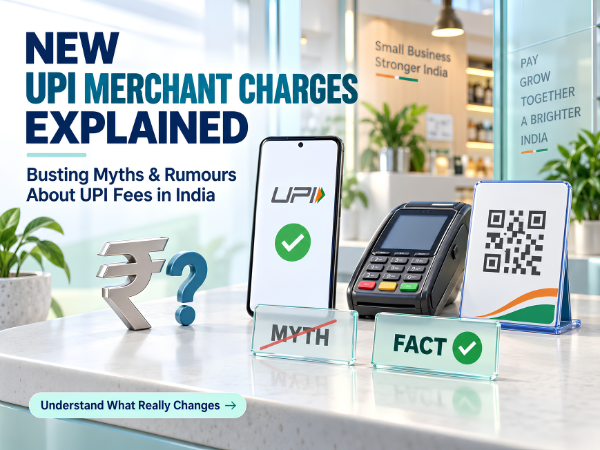
If you've recently seen messages claiming “UPI is no longer free,” “UPI payments above ₹2,000 will be charged,” or “customers will have to pay extra for UPI,” there is an important distinction to understand.
India's UPI merchant-payment framework has changed in 2026, but ordinary customers are not being charged for making UPI payments. The new Merchant Discount Rate (MDR) applies only to specified merchant transactions, and the government says customers must not be made to pay that MDR. (Press Information Bureau)
So, what has actually changed, who pays the new charge, and what happens when you pay more than ₹2,000 at a shop?
Let's separate the facts from the rumours.
What Are the New UPI Merchant Charges in 2026?
Under the new framework announced by the Ministry of Finance, person-to-person (P2P) UPI transfers remain completely free, irrespective of the amount.
For merchant payments:
UPI payments up to ₹2,000: No MDR.
Specified merchant payments above ₹2,000: A nominal MDR of 0.4% applies.
Transactions of ₹75,000 and above: MDR is capped at ₹300 per transaction.
The government says around 96% of person-to-merchant UPI transactions will remain unaffected by MDR because they either fall below the ₹2,000 threshold or qualify under the zero-MDR framework for small merchants. (Press Information Bureau)
Most Important: Customers Do NOT Pay the MDR
This is where much of the confusion begins.
MDR stands for Merchant Discount Rate.
It is a charge within the merchant payment ecosystem, not a fee imposed on customers for making a UPI payment.
The Ministry of Finance explicitly states that customers will not pay MDR. Banks have also been advised to ensure merchants do not pass the MDR on to customers, while UPI app providers are prohibited from imposing platform fees or hidden charges on individuals. (Press Information Bureau)
So if you buy something worth ₹3,000 and pay through UPI, the new framework does not mean you should automatically be charged ₹3,012.
The applicable MDR is part of the merchant-payment ecosystem rather than a customer surcharge.
UPI Merchant Charges: Myths vs Facts
Several rumours are circulating around the new rules. Here's what the official information actually says.
Myth 1: "UPI Is No Longer Free"
Fact: UPI remains free for individual users.
All person-to-person UPI transactions continue to be free, regardless of the amount transferred. The government has also said there are no monthly quotas or tiered caps on free P2P usage. (Press Information Bureau)
If you send money to a friend or family member through UPI, the new merchant MDR framework doesn't turn that transfer into a paid service.
Myth 2: "Every UPI Payment Above ₹2,000 Will Be Charged"
Fact: The ₹2,000 threshold relates to applicable merchant MDR—not a fee charged to the customer.
Merchant payments up to ₹2,000 remain free of MDR. A 0.4% MDR applies only to specified P2M merchant transactions above ₹2,000. (Press Information Bureau)
So don't confuse:
₹2,000 MDR threshold
with
₹2,000 customer UPI fee threshold.
They are not the same thing.
Myth 3: "Sending ₹5,000 to a Friend Will Attract a UPI Charge"
Fact: No.
Person-to-person transactions remain free regardless of the amount, subject to applicable bank and UPI transaction limits. (Press Information Bureau)
For example:
You → Friend: ₹5,000
This is a P2P transaction, not a normal merchant payment.
The new merchant MDR does not apply simply because the transfer exceeds ₹2,000.
Myth 4: "Customers Have to Pay 0.4% Extra at Shops"
Fact: The 0.4% MDR is not a customer charge.
The Ministry of Finance specifically states that MDR is a charge within the merchant payment ecosystem and isn't a charge on customers making UPI payments. (Press Information Bureau)
Banks have been advised to ensure that merchants do not pass MDR charges on to customers.
Myth 5: "Every Small Shopkeeper Will Now Pay UPI Charges"
Fact: Small merchants have additional protection under the framework.
Small merchants, including street vendors, receiving up to ₹1 lakh per month through UPI QR codes under the P2PM category continue to have zero MDR on all transactions. (Press Information Bureau)
This means the change shouldn't automatically be interpreted as “every chaiwala, kirana shop or street vendor will now have to pay UPI fees.”
Myth 6: "Google Pay, PhonePe or Other UPI Apps Can Now Add a Platform Fee"
Fact: The government's clarification says UPI application providers are expressly prohibited from imposing platform fees or hidden charges on individuals under this framework. (Press Information Bureau)
Always review the transaction screen before approving any payment, but the new MDR should not be confused with a new UPI-app fee for ordinary users.
Myth 7: "UPI Payments Above ₹2,000 Now Have GST"
This rumour has circulated before.
In 2025, the Government specifically rejected claims that it was planning to impose GST on UPI transactions above ₹2,000, calling those claims false and misleading. (Press Information Bureau)
The 2026 change is about the merchant MDR framework, not a blanket GST being charged to consumers simply because their UPI payment exceeds ₹2,000. (Press Information Bureau)
Myth 8: "There Is Now a Limit on How Many Free UPI Payments I Can Make"
Fact: The new framework does not introduce a monthly quota of free UPI transactions for individuals.
The Ministry of Finance says individuals continue to have unlimited free usage without monthly quotas, volume restrictions or tiered caps on free P2P transactions. (Press Information Bureau)
Your bank may still impose daily transaction limits for security and risk-management purposes.
Those limits are not UPI charging thresholds.
What Is MDR and Why Has It Been Introduced?
Merchant Discount Rate (MDR) is a payment-processing charge associated with merchant transactions.
According to the government, the new framework is intended to help support the long-term sustainability of the UPI ecosystem, including continued investment in:
- Payment infrastructure
- Cybersecurity
- Fraud prevention
- Technology
- System resilience
- Expansion of digital payments
The government says MDR isn't a tax and isn't collected by the Government or NPCI. It is distributed among participants in the payment ecosystem, including banks and payment-application providers. (Press Information Bureau)
Are There Different Charges for Certain Sectors?
Yes.
The September 2026 Ministry of Finance clarification specifies different treatment for some categories.
For transactions above ₹2,000 in certain essential and thin-margin sectors—including railways, telecommunications, insurance, fuel and agricultural inputs—the applicable MDR is a flat ₹5 per transaction. (Press Information Bureau)
For specified capital-market transactions, including payments relating to mutual funds, securities, stockbrokers and dealers, the MDR is 0.02%, capped at ₹300 per transaction. (Press Information Bureau)
Again, these are merchant-payment rules, not additional UPI charges imposed on the individual making the payment.
Quick Guide to the New UPI Rules
|
Transaction |
What the 2026 framework says |
|
Send money to a friend |
Free |
|
Send money to family |
Free |
|
P2P transfer above ₹2,000 |
Free |
|
Merchant payment up to ₹2,000 |
Zero MDR |
|
Specified merchant payment above ₹2,000 |
0.4% MDR for merchant ecosystem |
|
Small merchant under applicable P2PM criteria |
Zero MDR |
|
Customer paying a merchant |
Customer does not pay MDR |
|
UPI app platform fee for individuals |
Prohibited under the framework |
The government estimates that only about 4% of merchant transactions will attract MDR, leaving approximately 96% unaffected. (Press Information Bureau)
What Should Customers Do If a Merchant Asks for Extra Money for UPI?
Suppose your bill is ₹5,000 and a merchant says:
“UPI karoge toh extra charge lagega because government ne UPI charge laga diya hai.”
That explanation would not accurately describe the new framework.
The Ministry of Finance says customers will not pay MDR, and banks have been advised to ensure merchants don't pass MDR charges on to customers. (Press Information Bureau)
Before paying, ask the merchant to clarify why an additional amount is being requested.
Also check the final amount displayed in your UPI application before entering your UPI PIN.
Don't Believe Every Viral UPI Message
UPI rules affect hundreds of millions of users, so even a small policy change can quickly generate misleading WhatsApp forwards, social-media posts and headlines.
Before believing claims such as:
“UPI is chargeable now”
“₹2,000 ke upar UPI payment par charge lagega”
“Every shopkeeper has to pay UPI fees”
or
“Government is charging customers 0.4% on UPI”
check official information from the Ministry of Finance, RBI or NPCI.
The government's latest clarification is straightforward: P2P transactions remain free, customers do not pay MDR, merchant payments up to ₹2,000 remain free of MDR, and around 96% of merchant transactions are expected to remain unaffected. (Press Information Bureau)
Read the Ministry of Finance's latest UPI clarification
Keep Your Phone Ready for Secure UPI Payments
Whether you're using UPI Scan & Pay, UPI LITE, Tap & Pay or regular bank-to-bank UPI transfers, keep your smartphone software updated and never share your UPI PIN or OTP with anyone.
If you're experiencing a software, NFC, network or other device-related problem on your TECNO, Infinix or itel smartphone, Carlcare provides official after-sales support in India.
📞 Carlcare Toll-Free: 1800-4190-525
📍 Find a Carlcare Service Center
UPI rules and payment regulations can change. The information above reflects the Ministry of Finance clarification issued on September 15, 2026. Always check the latest official RBI, NPCI or Ministry of Finance guidance for subsequent changes.